Wednesday, April 8, 2009

5 de la Mañana: April 8, 2009


The top story from the Americas in the New York Times, Washington Post, and LA Times this morning is from Peru where former President Alberto Fujimori was convicted of human rights abuses and sentenced to 25 years in prison. The charges included responsibility for the killings of 25 people by a military death squad in the 1990s as the country fought Maoist guerrilla rebels. The NYT writes that Mr. Fujimori’s trial has been closely watched by specialists in international human rights law because of its implications for other former or current heads of state who might face charges of war crimes and other abuses. The official conviction included charges of murder, aggravated kidnapping and battery, as well as crimes against humanity, but the ex-president still awaits two additional trials on corruption charges that might add to the list of offenses. The WaPo adds that the Fujimori case marked the first time that an elected head of state has been extradited back to his home country, tried, and convicted for human rights violations. Fujimori had fled to Japan in 2000 and arrived in Chile in 2005 with a plan to return to power in Peru, but he was extradited by Chile in 2007 to stand trial. In the LAT report, Francisco Soberon, leader of the Aprodeh human rights group in Lima, which led the legal campaign to bring Fujimori to trial, says, “They couldn't shut us up. . . . Our objective is to achieve full justice, remembrance and reparations.” Maria McFarland, an international observer at the trial from the New York-based Human Rights Watch, said, “With this ruling, and its exemplary performance during the trial, the Peruvian court has shown the world that even former heads of state cannot expect to get away with serious crimes.” Keiko Fujimori, the ex-president’s 33-year-old daughter who is a leading candidate for president in 2011, had a very different reaction to the court’s decision, saying people's outrage over Tuesday's ''vengeful'' verdict will propel her to Peru's presidency where she would pardon her father.

In other major news, an AP story in the Wall Street Journal reports that Venezuelan President Hugo Chávez says his two-day visit to China is part of the creation of a new, multipolar world order. He noted two other countries he has already visited on his global tour, Japan and Iran, as others who are offsetting U.S. influence around the world. While the piece reports that China’s communist leaders have been low-key in response to Mr. Chavez's political rhetoric, Chinese industries have been eager to use Venezuela as a jumping-off point for their entry into South America. Major investments have been made in the mining and petroleum sector in order to secure South American mineral resources. Mr. Chavez said he plans to review with Chinese leaders the joint objective of boosting exports of Venezuelan oil to China from 380,000 barrels last year to 1 million barrels by 2013.

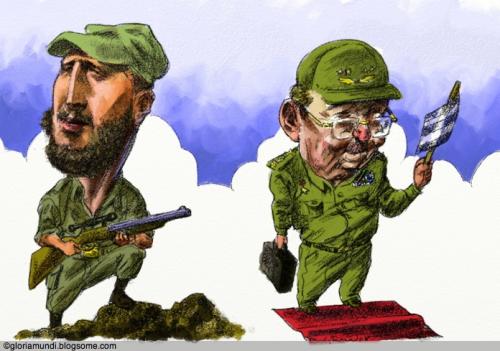
And the Miami Herald writes that a Congressional Black Caucus delegation, led by chairwoman Barbara Lee (D-CA), met with both Fidel and Raúl Castro during their recent five-day visit to Cuba. The group of House members said the Castro government is interested in talking to the United States. The meetings were first meeting between Raúl Castro and U.S. lawmakers since he assumed the presidency in mid 2006 and the first with the elder Castro since he took ill that same year. The MH reports that the members of Congress plan to brief House Speaker Nancy Pelosi, President Obama and Secretary of State Hillary Clinton on the trip—and push the administration to go further in loosening restrictions on Cuba—upon their return to Washington. The AP adds that Fidel Castro, in a piece published on a State-run website on Tuesday night, said “The three [member of Congress with whom he met] reflected transparency, pride in their work, their organization and the fight for their country. It’s evident that they know Obama and have confidence and security in, and sympathy for him.'”

Also in the WSJ, a report says large public-employee pension funds of New York City, as well as those of the states of New York, Maryland and Pennsylvania are raising concerns about an impending court judgment that might hold Chevron Corporation liable for alleged environmental damages in the Ecuadorian jungle. According to the WSJ, the funds hold about $1 billion in Chevron shares. Chevron faces $27 billion in damages in Ecuador, an amount that greatly dwarf the $3.5 billion that Exxon was forced to pay for cleanup, fines, and damages after the 1989 Valdez oil spill.

From the MH, the AP reports that pro-Chávez lawmakers in Venezuela approved a new law Tuesday that erodes the authority of Caracas' opposition mayor by subordinating him to a government-appointed official. According to the AP, a new official, who will be appointed directly by Chavez, will be granted administrative authority over Venezuela's capital. Mayor Antonio Ledezma, who defeated a Chavez-backed candidate in November elections, plans to challenge the new law through a referendum. For their part, Chávez supporters have argued that the new position would help resolve problems such as inadequate trash collection because it establishes a direct link between the federal government and the city's top administrator.

And two opinions on Venezuela-U.S. relations in the MH today. Columnist Andres Oppenheimer reports that despite recent speculation that President Barack Obama will hold a private meeting with Venezuelan President Hugo Chávez at next week's Summit of the Americas in Trinidad and Tobago, the State Department said Tuesday that no such one-on-one meeting would happen. Instead, Obama will hold three separate group meetings, one of which will include President Chávez, in addition to the official closed-door session between all participating heads of government. Oppenheimer describes such a strategy as safe, saying it “won’t be an olive branch, nor a snub.” Professor Anthony Maignot, in a separate MH opinion piece, adds that Obama’s best strategy for dealing with a Chávez who is “looking for a fight” will be one of dignified silence. The professor writes: “Hispanics have a wonderful expression for such a stance: Lo cortés no quita lo valiente (Being chivalrous does not negate your courage).”

Tuesday, April 7, 2009

5 de la Mañana: April 7, 2009


The top story from the Americas in the New York Times, Wall Street Journal, and Miami Herald this morning is again from Cuba where all three papers run an AP story about a meeting between Raúl Castro and six U.S. lawmakers in Havana. The lawmakers, led by Congressional Black Caucus chairwoman, Barbara Lee (D-CA), were the first U.S. leaders to meet with the younger Castro since he assumed the presidency in 2006. An official communiqué provided no details of what was discussed or how long the meeting lasted, but did say the group of U.S. legislators also met with the head of parliament and Cuba’s foreign minister. After praising Senator Richard Lugar (R-IN) in a Monday column that ran in a Cuban state newspaper, Fidel Castro also saluted the members of the Congressional Black Caucus for traveling to the island in a piece posted late Monday night on a government Web site. The former leader said he “values the gesture of the legislative group, adding that “it's unlikely that the delegation has seen a face twisted with an expression of hate, and maybe they admire the total absence of illiterate people or children shining shoes in the street.” In a separate MH piece, White House advisor to the upcoming Summit of the Americas, Jeffrey Davidow, confirmed on Monday that President Barack Obama intended to ease family travel and remittances to Cuba in the coming days, while adding that the administration hopes Cuba will not dominate next week’s gathering of the 34 hemispheric leaders in Trinidad and Tobago. Mr. Davidow would not rule out a meeting between Obama and Venezuelan President Hugo Chávez either

From the Washington Post, more on Cuba in an opinion piece from yesterday by Marc Thiessen, former spokesman for the Senate Foreign Relations Committee under past conservative chairman, ex-Senator Jesse Helms (R-NC). Reacting to the announcement that the Obama administration would lift travel and remittance restrictions, Thiessen writes that Raúl Castro is a little respected figure within the Cuban hierarchy and that leadership infighting within Cuba centers around who can end the U.S. embargo. Thus, according to Thiessen, the embargo and other restrictions should not be lifted as they remain the U.S.’s best leverage for strengthening democracy and influencing who Castro’s successor might be.

And in the LA Times an opinion piece from a Drug Policy Alliance associate says that with drug-fuelled violence raging in Mexico, President Obama has yet to go far enough in supporting changes to U.S. marijuana policy. The piece cites the drug policy findings of the Latin America Commission on Drugs and Democracy which urged policymakers to spark public debate on the decriminalization of marijuana and other measures. However, the writer argues that in a recent online town hall meeting, President Obama brushed off questions about changing marijuana policy jokingly. “I don't know what this says about the online audience. This was a fairly popular question; we want to make sure that it was answered. The answer is no, I don't think that's a good strategy to grow our economy,” the op-ed reports Obama saying.

Also in the WSJ, more from Cuba. The paper reports that while the U.S. has limited the entry of immigrants to the United States during the global economic downturn, it has expanded the number of U.S.-bound migrants who can establish that they are citizens of Cuba, even if they have never set foot on the island. According to Homeland Security records, in just the last fiscal year, nearly 41,000 residence permits were issued to foreigners asking to stay under the Cuban Adjustment Act of 1966. Of those permits, more than 3,400 were born in a country other than Cuba, up from 2,725 applicants with a similar status during the previous fiscal year. Curiously, the paper reports that even nine Cubans were admitted from Ukraine.

In an opinion piece running today in the MH, the chairmen of the House Foreign Affairs, Armed Services, and Intelligence Committees together argue that talk of Mexico as a failed state is nonsense but add that the U.S. must aid Mexico by fully funding the three-year, $1.4 billion Mérida Initiative. However, the three House chairmen argue that the initiative alone is not enough and say a comprehensive, cross-jurisdictional domestic effort to complement Mérida is needed, along with a Mérida central coordinator perhaps sitting on the National Security Council. Lastly, Congressmen Howard Berman, Ike Skelton, and Silvestre Reyes propose authorizing the president to “establish a Western Hemisphere drug policy commission to review and assess the critical steps required to tackle more effectively the scourge of illegal drugs and its attendant violence.” The three men recently traveled to Mexico to meet with Mexican drug officials.

Finally, two additional notes of interest in the MH. First, an AP report on Venezuela says that country has reached an agreement with Japan to deepen ties in energy, investment and trade, with Japanese companies ready to participate in gas and crude production in Venezuela shortly. Chávez has said Venezuela expects $500 million in Japanese investment to help upgrade Venezuela's Puerto La Cruz refinery. And finally, ahead of next week’s Haiti donors conference in Washington, D.C., a top U.N. official says Haiti's economy has been battered by $1 billion in damage from last year's hurricanes and a drop in money transfers from Haitians working abroad, primarily caused by the global financial crisis.

Monday, April 6, 2009

5 de la Mañana: April 4-6, 2009


The top stories from the Americas in the New York Times and Wall Street Journal over the weekend deal with the forthcoming U.S. loosening of travel restrictions to Cuba. According to the NYT, an administration official said Saturday that President Obama will abandon long-standing restrictions on family travel and remittances ahead of the Fifth Summit of the Americas, scheduled to begin April17. The unnamed official added that the precise details of the plan are still being worked out, and the paper writes that the president is not expected to call for the lifting of the trade embargo on Cuba—an action which would require Congressional approval. The WSJ, who broke the story, reports that in 2004, President George W. Bush tightened the rules on family travel, allowing trips just once every three years, and narrowing the definition of who qualified as family. The paper says sisters, brothers, mothers, fathers and grandparents qualified, but uncles, aunts and cousins did not. In a separate article, a NYT piece on political happenings inside Cuba says that a government shakeup that led to the recent removal of a half-dozen top Cuban officials has not yet brought political reform, but rather “politics and decision-making are likely to remain as centralized and tightly controlled as they were under his [Raúl Castro’s] brother.” Minor changes have been seen in the country’s education and healthcare system with the younger Castro trying to get retired teachers to return to work while also making sure that foreign medical programs do not leave parts of the island without medical care. And, finally, a Reuters article in the NYT says that former Cuban president Fidel Castro has praised U.S. Senator Richard Lugar for calling for a new U.S. policy of engagement with the communist-led island. In a column published on the internet, Castro wrote that Lugar has "his feet on the ground" and does not fear that he will be called “soft or pro-socialist” in making the argument that the measures of the United States against Cuba, throughout almost half a century, constitute a total failure.”

From the Washington Post, two articles on drugs, border violence and Mexico over the weekend. The paper writes that after pledging $1.4 billion to help fight drug trafficking in Mexico through the Mérida Initiative last year, the U.S. has spent almost nothing. According to the WaPo, with the first tranche of $400 million long ago appropriated for Mexico, just two small projects have been completed-- the delivery of high-speed computer servers in December and an arms-trafficking workshop attended by senior U.S. officials at a Mexican resort last week. U.S. officials acknowledged that about $7 million from the aid package has been spent on administrative items, and say a $50 million surveillance plane and five rapid-response helicopters, may take as long as two years to deliver to their Mexican counterparts. The monies provided under Merida Initiative are 10 times as large as any previous American anti-drug assistance package to Mexico, and the Mexican government will receive about $116.5 million in foreign military financing under the first installment of Merida—the fifth largest amount in any State Department military financing program. In a separate article, the WaPo interviews Arizona Attorney General Terry Goddard about drug laws, border violence, and the increasingly creative ways traffickers are getting drugs into the U.S. And an opinion piece by two U.S. Customs and Border Protection officials calls for an increased U.S. effort in fighting drug cartels and organized crime in Mexico, arguing that the “U.S. strategy should be not just to bolster our borders but to help Mexico establish the rule of law and score a decisive victory against the cartels.”

And the LA Times and Miami Herald both have more reports on the end of the Alberto Fujimori in Peru. A verdict is expected this week in the case, and the LAT writes that on the last day of the trial, “Fujimori portrayed himself as the nation's savior,” saying he was facing a guerrilla group that at one time controlled nearly two-thirds of Peru's territory. The MH adds how Fujimori has claimed that the charges and trial reflect a double standard since his predecessors never faced trial for alleged abuses during their presidencies. In particular, the former Peruvian president identified current President Alan Garcia, who also governed Peru from 1985-1990, and was never charged for massacres allegedly committed during his first term in office.

Also in the NYT, a briefing report on Venezuelan President Hugo Chávez’s visit to Iran says that the two countries will form a development bank to finance projects in their respective countries. The new Bi-National Iranian Venezuelan Bank will be based in Tehran with $100 million of startup capital from each country.

In two additional reports in the WaPo, an opinion piece in the paper by White House correspondent Scott Wilson says that while military strategists have often looked to Iraq as a model for creating a new mission in Afghanistan, Colombia would be a better example from which to learn. In the article the Wilson, a former Colombia and Iraq correspondent for the paper, says: assisted by billions of dollars in U.S. military and development aid, the Colombian government has pushed a Marxist insurgency deep into the jungles where it was born four decades ago. Isn't that what Obama wants to accomplish in Afghanistan? Struggles financed by drug profits, difficult terrain, and a lack of a strong central government are among the similarities Wilson writes. And, a WaPo story from Argentina on the legislative approval last week of the President Cristina Fernandez de Kirchner’s plan to move up the congressional elections by four months, from late October to June 28.

From the MH, a story on the test Obama will face in his Latin American debut at the Summit of the Americas in Trinidad and Tobago. The scheduled agenda is expected to include six topics, the MH reports: prosperity, energy, the environment, security, democratic governance and the summit process itself.

Lastly, three more opinion pieces from columnists at the WSJ, LAT, and MH. At the WSJ, Mary O’Grady’s column reacts to Treasury Secretary Tim Geithner’s trip to Medellin, Colombia for the Inter-American Development Bank’s general assembly. As the IAD pledged more aid, she provocatively writes that “Latin America remains poor and backward not despite multilateral “assistance” but, in a large part, because of it,” arguing that more economic liberty, not foreign aid is what the region needs to fight poverty. At the LAT, Gregory Rodriguez writes that the drug war in Mexico will have two little examined effects on immigrants in the U.S. First, it will likely increase anti-immigrant sentiment in the U.S., and second, as “Mexican newcomers look back at their increasingly dangerous homeland, they will -- consciously or unconsciously -- set down deeper roots in the United States.” And, in the MH, Andres Oppenheimer writes that the push by some U.S. legislators to end travel restrictions to Cuba is not likely to bring democracy to the island. He says the U.S. should end the travel ban but “this should be done based on Americans' rights to freely travel anywhere” and not on “on false assumptions that a flood of U.S. visitors will spark an outcry for democracy on the island.”


Friday, April 3, 2009

5 de la Mañana : April 3, 2009


The top story from the Americas in the New York Times this morning is from Brazil where the paper writes that President Luiz Ignacio Lula da Silva may see a drop in his domestic popularity as industrial production falls and unemployment rises in his country. Over the years, Lula has gained the reputation of one of the developing world’s most forceful advocates, says the NYT, but three new polls show a recent drop in his previously high approval ratings and much controversy over comments made last week, in which he blamed “white people with blue eyes” for the economic crisis. According to the NYT, these comments set off a wave of fury among Brazil’s elites, many of whom resent the popularity of Mr. da Silva, a former metal worker with a fourth-grade education. Brazil’s gross domestic product fell by 3.6% in the last quarter of 2008 from its third quarter numbers, the worst drop of any Latin American nation. The country also lost 654,946 jobs in December 2008, and 101,748 more jobs in January.

From the Washington Post, a piece on the continuing debate over changes in U.S. policy toward Cuba. The report says that Senator Richard Lugar (R-IN) has called on President Obama in a personal letter to appoint a special envoy to initiate direct talks with the island's government and to end U.S. opposition to Cuba's membership in the Organization of American States. According to the WaPo, Lugar added that the nearly 50 year-old embargo puts the United States at odds with the views of the rest of Latin America, the European Union and the United Nations, and “undermines our broader security and political interests in the Western Hemisphere.” The Indiana Republican is a co-sponsor of a bipartisan bill introduced in the Senate this week that would end all restrictions on travel to Cuba, except in cases of war or direct threats to health or safety. Lifting all restrictions -- and the trade embargo -- requires legislation, says the WaPo.

Both the Wall Street Journal and the Miami Herald have lead reports this morning from Venezuela where President Hugo Chávez has ordered the jailing of a former defense minister turned government critic, Raúl Baduel. Mr. Baduel was arrested on corruption charges Thursday. The MH writes that military prosecutor Ernesto Cedeño said there was ''sufficient proof'' to justify charging Baduel with stealing “a large amount of money from the armed forces.” He added that formal charges would be laid out within 30 to 45 days. The WSJ adds that this new arrest comes after the Venezuelan attorney general sought a court order in late March to arrest Manuel Rosales, a former state governor who ran for president against Mr. Chávez in the 2006. Rosales has since gone into hiding, representatives for the politician now say. A former general, Mr. Baduel was once a close friend to Mr. Chávez and played a key role in restoring him to power after a brief coup in 2002. However, Baduel emerged as an opposition figure in 2007, when he helped turn public opinion against a referendum to give Chávez the right to unlimited re-election.

And the LA Times and many others publish a report from Mexico on the arrest of the suspected No. 2 kingpin in the Juarez drug cartel. Mexican authorities on Thursday announced the capture of Vicente Carrillo Leyva, son of late drug lord, Amado Carrillo Fuentes, in Mexico City. Mr. Carrillo Leyva, 32 years old, had a $2 million reward on his head and was paraded before reporters in a white, Abercrombie & Fitch track suit after his arrest, reports the LAT. He is known as “The Engineer,” says the WSJ, and he is allegedly a member of a generation of educated “narco-juniors,” a group of heirs to family-run drug empires. The LAT adds that Carrillo's uncle, Vicente Carrillo Fuentes, known as "the Viceroy," remains free as the leader of the Juarez cartel, one of the four largest trafficking organizations in Mexico.

Also the NYT, WaPo, and WSJ, all report from Mexico on meetings between top U.S. officials and their Mexican counterparts about border issues Thursday. The details of the agreements were not finished, U.S. officials said, but they are to be announced when President Obama visits Mexico later this month. It is expected that the new measures will improve cooperation in investigating and prosecuting gun smugglers, to upgrade shared fingerprint databases and to increase inspections of vehicles coming into Mexico, according to the NYT. The WaPo has a more skeptical analysis, writing that an announcement by Mexican officials that “an agreement to create a joint working group that could produce a timely report” signifies that little progress was made. The WSJ adds that participating in the meetings were U.S. Attorney General Eric Holder, Homeland Security Secretary Janet Napolitano, and Eduardo Medina Mora, Mexico's attorney general, among other Mexican security officials.

On discussions about easing restrictions on travel to and trade with Cuba, the MH reports that Senator Mel Martinez (R-FL) has also issued a letter to President Obama, albeit from what he calls the perspective of a “dissident.” In the note, Martinez asks President Barack Obama not to “'put commercial considerations ahead of political freedom” for Cubans on the island. Mr. Martinez phoned famous Cuban hunger striker Jorge Luis ''Antúnez'' García after sending the letter, praising him for bringing attention to Cuba's human rights record.

From the LAT, a report from the U.S. border county of Starr County, Texas, what the paper calls an economically “booming” area where “unemployment is half of what it was a decade ago, sales tax revenue is up, and the median income is rising.” The catch: illicit gains from the drug trade seem to be playing at least some role in that renaissance as traffickers “feel they can buy law enforcement.”

And, finally, a strange editorial in the WaPo today on how the “fiscally strapped D.C. government” allegedly tried to donate old city fire equipment to the small Dominican community of Sosúa, through a D.C.-based peace organization.